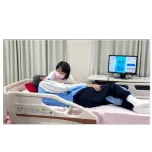
NEO M-Physical AI Smart Mattress, individually optimized mattress platform

NEO M-Physical AI Smart Mattress, individually optimized mattress platform

AI-Powered Robotic Care Assistants
NEO M-Physical AI Smart Mattress, individually optimized mattress platform

Information

NEOM-Physical AI Smart Mattress is a personalized physical AI-based mattress platform for preventing bedsores and reducing nursing staff load and costs. NEOM is a Physical AI–based adaptive mattress system designed to reduce the burden of immobility care on healthcare professionals while improving preventive outcomes for patients. In hospitals and long-term care facilities, pressure injury prevention and repositioning remain highly labor-intensive tasks that rely heavily on manual intervention. Under persistent nursing shortages and rising labor costs, maintaining consistent preventive care through manual routines alone has become increasingly difficult. NEOM addresses this challenge by embedding continuous preventive functionality directly into the mattress. Based on a high-resolution air-cell architecture with more than 96 individually controllable cells, the system continuously monitors pressure distribution, posture, and micro-movement. Using closed-loop control and Physical AI algorithms, it autonomously generates adaptive micro-motion and pressure redistribution tailored to patient-specific conditions. By automating routine preventive care at the support surface level, AIM-BED reduces the frequency and physical burden of manual repositioning. This protects caregivers from repetitive strain while allowing nursing staff to focus on higher-value clinical tasks. At the same time, reduced pressure injury incidence contributes to lower treatment costs and improved operational efficiency. NEOM transforms the medical mattress from a passive support surface into an active component of care delivery, supporting safer, more sustainable healthcare environments for both patients and caregivers.

NEOABLE CO., LTD.S5.A76NEOABLE is built upon the core principle of “Moving Technology for Care,” offering a breakthrough alternative to conventional static medical products. The company’s core devices —NEOX (smart electric cushion), NEO-M (AI-powered mattress), and NEOSONIX (vibration therapy device) —utilize automated pressure redistribution and sensor-based response systems, making them ideally suited for aging societies and rehabilitation-focused medical facilities. The business model goes beyond traditional hardware sales. It follows a phased pathway of clinical validation → insurance integration → institutional procurement, enabling a hybrid B2B+B2G model. With proven compatibility for institutional markets such as Japan’s Kaigo insurance system, European hospital purchasing structures, and public tenders in the Middle East, NEOABLE is positioned for scalable impact. Strengths - Proprietary “Moving-Tech” platform offering real-time, responsive pressure relief - Certified (CE, ISO13485) and proven in regulated markets (e.g., Japan), Clear clinical differentiation from passive competitors (ROHO, JAY) - Hybrid business model (B2B + B2G) adaptable to hospital, insurance, and government channels - Strong early traction: 3.7M USD Japan contract, pilot tests in UAE & Saudi Arabia Weaknesses - Limited brand awareness in non-Asian markets (e.g., Europe, Middle East) - Capital-intensive scaling model (AI/motorized products require more production resources) - Product localization (language, regulatory, insurance systems) needed per region Opportunities - Global aging population fueling demand for ulcer prevention and elderly care solutions - Rising public health investments in GCC countries and Southeast Asia - Entry into insurance-backed systems (Kaigo, EU DRG, Middle East’s e-claims) Threats - Price-sensitive procurement markets may favor low-cost static competitors - Market entry dependent on regulatory approvals and pilot outcomes - Geopolitical instability or policy shifts in emerging regions (e.g., Middle East tender cycles), Risk of low-cost imitation in low-barrier regions

Log in

See all the content and easy-to-use features by logging in or registering!